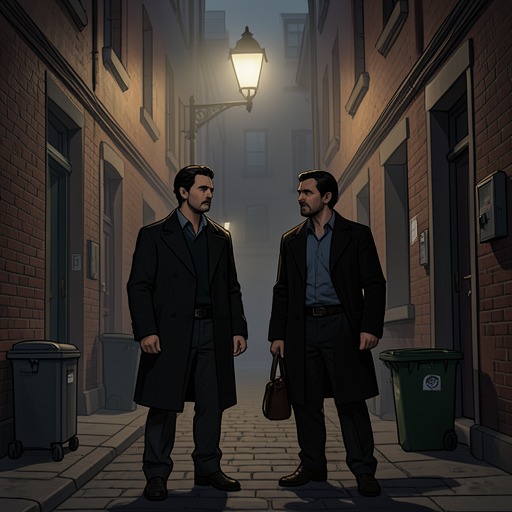
Brad and Jim’s romantic partnership
Naked LunchBrad and Jim’s romantic partnership is a short-lived bond built against economic vulnerability and social pressure. After meeting through gambling, the two men share a modest home and work, and their ordinary routines briefly offer a picture of happiness; their final domestic scene, however, turns that apparent refuge into a disturbing reversal, underscoring how little safety the story allows intimacy to keep.
Formation and Circumstances
Brad arrives in New York from Texas and makes a living designing costume jewelry and jewelry sets for wealthy older women. His work brings money and social access, but leaves little time for sex, while his concern for his reputation and his attempts to appear more conventionally masculine lead him to horse-race gambling. That decision brings him into a betting booth with Jim, described as a hustler; the narrative presents their attachment as love, or at least its convincing likeness.
The two are released from their respective circumstances at roughly the same time and take up residence in a Lower East Side flat. They cook there and hold modest legitimate jobs. The account marks this shared arrangement as their first experience of happiness, grounding the relationship not in grand declarations but in the practical fact of making a home and living together.
Pressure on Their Shared Life
Their domestic life faces pressure from two directions. Lucy Bradshinkel returns, saying that all is forgiven and offering to set Brad up in a studio. The opportunity is conditional: Brad would have to move to the East Sixties, away from the life he has established with Jim. Lucy dismisses their current place as impossible and disparages Jim, making her offer both material assistance and a challenge to the partnership.
Jim, meanwhile, receives an offer from a criminal group to return as a driver. The work is presented as a step up, with the added appeal that its sponsors would hardly see him before. The competing offers put the men’s ordinary household against separate forms of advancement: Brad is invited into a more comfortable artistic arrangement, while Jim is tempted back toward crime. The narrative asks whether either will yield, then reports that the forces pressing them are routed, at least for the moment.
Domestic Image and Reversal
The men stand together at their tenement window, arms around each other as they look toward the Brooklyn Bridge. Their shared posture makes the relationship visible as mutual attachment, while the city landmark frames the small room as a vantage point on a larger world. The scene then narrows to supper. Jim asks what is planned; Brad playfully sends him out of the kitchen and puts on an apron, giving their partnership a moment of ordinary, reciprocal domesticity.
That routine ends in a macabre shock: the meal is Lucy Bradshinkel, prepared and served by Brad, and the men eat while looking into each other’s eyes. The ending converts the threatened domestic scene into an act of grotesque incorporation. It does not simply resolve the offers by showing the couple together; it makes their apparent unity depend on a shocking transformation of the rival who had tried to draw Brad away.
Narrative Significance
The relationship is presented as a compact romantic plot inside a work whose broader world is crowded with coercion, disorder, and abrupt changes of register. Its recognizable arc—from meeting and shared happiness, through rival claims on each man, to a paired ending—offers the shape of a domestic romance, but the final meal overturns any uncomplicated promise of security. The men remain together in the closing image, yet the means by which that image is achieved makes the partnership’s apparent triumph inseparable from the narrative’s grotesque instability.